

Electronic Nose Market Outlook 2025–2035, Key Drivers, Market Share, Segmentation & Emerging Trends
electronic nose market
Electronic Nose Market Size, Share and Research Report By Product Type (Portable Electronic Noses, Fixed Electronic Noses, Handheld Electronic Noses)
The electronic nose market is gaining momentum with increasing applications in healthcare, food quality monitoring, and environmental sensing.”
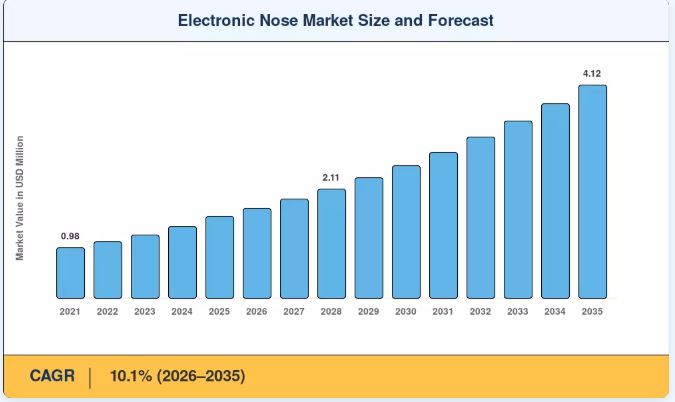
NEW YORK,, CA, UNITED STATES, June 16, 2026 /EINPresswire.com/ -- The Global electronic nose market reached an estimated USD 1.58 billion in 2025 and is projected to grow from USD 1.74 billion in 2026 to USD 4.12 billion by 2035, registering a CAGR of 10.1% during the forecast period. — Market Research Future (MRFR)
Two major catalysts are accelerating this trajectory: the escalating deployment of e-nose technology in food quality assurance and safety applications where regulatory agencies across the EU, US, and Asia-Pacific now mandate non-invasive spoilage detection at production scale and rapidly advancing sensor array miniaturization that has reduced device footprints by over 60% since 2020.
With electronic olfaction systems now embedded across food & beverage, environmental monitoring, healthcare diagnostics, and defense sectors, the technology is transitioning from specialized laboratory instrumentation to mission-critical field-deployable infrastructure.
Legacy chemical analysis methods gas chromatography, mass spectrometry, and manual sensory panels are progressively being supplemented and, in many applications, replaced by AI-enhanced electronic nose systems capable of real-time, non-destructive volatile compound analysis.
A recent study published in the Journal of Food Engineering estimated that e-nose systems integrated with machine learning pattern recognition achieved 94–97% accuracy in detecting adulteration and freshness indicators across dairy, meat, and beverage product categories. This analytical shift is not incremental it represents a fundamental re-platforming of how industries sense, classify, and respond to chemical and biological signals.
Get Full PDF Sample Copy of Report: (Including Full TOC, List of Tables & Figures, Chart) @
https://www.marketresearchfuture.com/sample_request/22638
➤How Significant Is the Electronic Nose Market’s Growth?
The electronic nose market has demonstrated consistent and accelerating expansion, rising from approximately USD 42.1 million in 2021 to an estimated USD 1.58 billion in 2025, representing a robust historical growth trajectory. The market is poised to more than double over the next decade, driven by intensifying food safety regulations, a surge in portable environmental monitoring requirements, and the growing adoption of non-invasive disease diagnostics using breath analysis in clinical and point-of-care settings.
Rising concerns over food fraud, contamination events, and the economic cost of spoilage in global supply chains have created acute demand for rapid, automated olfactory sensing systems. Pharmaceutical manufacturers, agricultural processors, environmental agencies, and defense procurement agencies are all investing in e-nose platforms to reduce reliance on costly laboratory analysis, accelerate quality control workflows, and enable real-time detection of hazardous or off-specification compounds at source.
➤What Does the Future Hold for the Electronic Nose Market?
Artificial intelligence and advanced sensor fusion stand at the forefront of the market’s next growth phase. Modern electronic nose platforms are moving beyond single-sensor detection toward multi-modal arrays that combine metal oxide semiconductor (MOS), conducting polymer, quartz crystal microbalance (QCM), and optical sensors processed by deep learning classifiers capable of recognizing complex volatile organic compound (VOC) fingerprints with sub-ppm sensitivity. These AI-enhanced platforms are enabling entirely new application categories, including early-stage cancer screening via exhaled breath analysis, explosive trace detection at transport security checkpoints, and precision fermentation monitoring in beverage production.
The miniaturization and integration of e-nose technology into wearable and IoT-connected devices is another defining force shaping the market’s future. Next-generation solid-state sensor arrays capable of operating on microcontroller-class hardware are enabling continuous environmental monitoring in smart buildings, industrial facilities, and agricultural environments with data streamed in real time to cloud analytics platforms for trend analysis and anomaly alerting.
The convergence of e-nose sensing with edge AI inference chips is expected to make autonomous chemical intelligence ubiquitous across industrial, consumer, and medical device ecosystems.
Healthcare applications are poised to be the highest-growth segment through 2035. Non-invasive breath-based diagnostics for conditions including lung cancer, diabetes, kidney disease, and infectious diseases including post-COVID long-term respiratory monitoring are attracting significant R&D investment and regulatory attention. The FDA’s Breakthrough Device Designation framework is actively accelerating clinical validation pathways for breath biomarker-based diagnostics, with over a dozen e-nose diagnostic platforms currently in late-stage clinical trials globally.
➤Who Are the Key Players in the Electronic Nose Market?
The electronic nose landscape is characterized by a mix of established analytical instrumentation vendors, specialized sensor technology developers, and emerging AI-driven olfaction startups. Key participants shaping the competitive dynamics include:
✿Alpha MOS
✿Airsense Analytics GmbH
✿The eNose Company
✿Aryballe Technologies
✿Odotech (Envirosuite)
✿Sensigent LLC
✿Electronic Sensor Technology (EST)
✿Owlstone Medical
✿Scent Sciences Corporation
✿RoboScientific
Competition in the market is intensifying as vendors race to embed generative AI and deep learning into sensor signal processing pipelines, develop standardized VOC reference libraries for cross-platform interoperability, and pursue regulatory clearances for clinical-grade breath diagnostic applications. Strategic partnerships with clinical research organizations (CROs), food industry consortia, and defense procurement agencies are reshaping go-to-market strategies across the vendor landscape.
➤What Are the Emerging Trends in the Electronic Nose Market?
Several transformational trends are redefining how the electronic nose market evolves through 2035:
AI-Enhanced Pattern Recognition: Deep learning models trained on large VOC fingerprint databases are dramatically improving classification accuracy across complex, multi-component odor matrices enabling reliable detection even in high-humidity, variable-temperature field environments.
Breath Biomarker Diagnostics: Electronic nose systems are emerging as a transformative tool in non-invasive clinical diagnostics, with breath-based biomarker panels showing strong sensitivity and specificity for oncology, metabolic disease, and infectious disease screening.
IoT-Connected Distributed Sensing Networks: Networked arrays of low-cost, miniaturized e-nose nodes are enabling continuous area-wide chemical monitoring for smart cities, industrial fence-line monitoring, and agricultural field surveillance.
Food Authentication & Anti-Adulteration: Regulatory pressure and consumer demand for provenance verification are driving adoption of e-nose systems for geographic origin authentication, adulteration detection, and shelf-life optimization across premium food and beverage categories.
Defense & Security Applications: Investment in e-nose systems for explosive trace detection, chemical warfare agent sensing, and narcotic identification at border security checkpoints is accelerating globally, supported by NATO and DHS procurement frameworks.
Pharmaceutical Process Analytical Technology (PAT): Real-time VOC monitoring during pharmaceutical manufacturing including fermentation, lyophilization, and packaging integrity testing is becoming a compliance requirement under evolving FDA and EMA quality-by-design frameworks.
Get access to the full description of the report @
https://www.marketresearchfuture.com/reports/electronic-nose-market-22638
➤How Is the Electronic Nose Market Segmented?
The electronic nose market report provides a comprehensive segmentation framework:
By Sensor Technology: Metal Oxide Semiconductor (MOS), Conducting Polymer, Quartz Crystal Microbalance (QCM), Optical Sensors, Others
By Application: Food & Beverage Quality Control, Environmental Monitoring, Healthcare & Medical Diagnostics, Defense & Security, Industrial Process Control
By Product Type: Portable/Handheld Devices, Benchtop Instruments, Embedded/Integrated Systems
By End User: Food & Beverage Industry, Pharmaceutical & Healthcare, Environmental Agencies, Defense & Military, Research & Academia
By Organization Size: SMEs, Large Enterprises
➤What Are the Regional Insights from the Electronic Nose Market?
North America commands approximately 36% of global electronic nose market share, underpinned by strong defence and homeland security procurement budgets, advanced pharmaceutical manufacturing infrastructure, and the FDA’s active encouragement of breath diagnostics through its Breakthrough Device Designation pathway. The United States hosts the highest concentration of e-nose startups and clinical research programs globally, supported by NIH and DARPA research funding that is accelerating both sensor innovation and clinical validation pipelines.
Europe holds the second-largest share at approximately 28%, with Germany, France, the United Kingdom, and the Netherlands representing the primary markets. The EU’s stringent food safety regulations under Regulation (EC) No 178/2002, combined with REACH chemical compliance requirements, have driven significant adoption of automated olfactory sensing systems in food processing, environmental, and industrial applications. European academic institutions are also major contributors to fundamental e-nose research and sensor material innovation.
Asia-Pacific represents the fastest-growing region, driven by rapid expansion of food processing infrastructure in China and India, growing environmental monitoring mandates in Southeast Asian industrial corridors, and increasing R&D investment in biosensor technology at Japanese and South Korean research universities. The region’s large-scale agricultural sector is also emerging as a significant adopter of e-nose systems for crop disease detection, post-harvest quality assessment, and supply chain freshness monitoring.
The Middle East & Africa region is projected to register an above-average CAGR through 2035, driven by expanding petrochemical and industrial sector applications in the Gulf Cooperation Council (GCC) states, where electronic nose systems are being deployed for continuous ambient air quality and fugitive emission monitoring at oil & gas facilities. Growing investment in food safety infrastructure across the African continent is also creating incremental demand for affordable, field-deployable e-nose solutions.
Latin America rounds out the global picture, with Brazil, Mexico, and Argentina representing the most active markets. Brazil’s agri-food export sector the world’s largest supplier of soybeans, coffee, and beef is increasingly adopting e-nose quality assurance systems to meet EU and US import standards, while Mexico’s growing pharmaceutical and aerospace manufacturing base is creating incremental demand for industrial process monitoring applications.
➤FAQs
Q-Can an e-nose device fully replace gas chromatography–mass spectrometry in quality-control labs?
A- Not yet. E-nose devices excel at rapid pass/fail screening but lack the compound-level identification resolution of GC-MS. Most facilities deploy them as a first-stage filter, sending only flagged samples to GC-MS for confirmatory analysis
Q-What is the typical return on investment for e-nose deployment in food processing?
A- Industry case studies report 12–18-month payback periods driven by 30–45% reductions in product recall costs and 20% decreases in laboratory testing expenditure. ROI is highest in high-throughput meat and dairy operations
➤➤➤ Industry Analysis Reports by Market Research Future:
Optical Fingerprint Sensor Market -
https://www.marketresearchfuture.com/reports/optical-fingerprint-sensor-market-4750
Ar And Vr Smart Glasses Market -
https://www.marketresearchfuture.com/reports/ar-vr-smart-glasses-market-4837
Mass Flow Controller Market -
https://www.marketresearchfuture.com/reports/mass-flow-controller-market-4975
Warehouse Robotics Market -
https://www.marketresearchfuture.com/reports/warehouse-robotics-market-5039
Gaming Laptop Market -
https://www.marketresearchfuture.com/reports/gaming-laptop-market-5153
Pay-Card Reader Market -
https://www.marketresearchfuture.com/reports/pay-card-reader-market-5239
Quantum Sensors Market -
https://www.marketresearchfuture.com/reports/quantum-sensors-market-5273
Smart Connected Devices Market -
https://www.marketresearchfuture.com/reports/smart-connected-devices-market-5668
Pc Based Automation Market -
https://www.marketresearchfuture.com/reports/pc-based-automation-market-5717
Rf Test Equipment Market -
https://www.marketresearchfuture.com/reports/rf-test-equipment-market-5734
Sagar Kadam
Market Research Future
+ +1 628-258-0071
email us here
Visit us on social media:
LinkedIn
Facebook
X
Legal Disclaimer:
EIN Presswire provides this news content "as is" without warranty of any kind. We do not accept any responsibility or liability for the accuracy, content, images, videos, licenses, completeness, legality, or reliability of the information contained in this article. If you have any complaints or copyright issues related to this article, kindly contact the author above.
